Tuesday, October 21, 2008

Visit to "Good Morning America" 2008 for National Chemistry Week

Bill Suits, Bobbie Gorman and I left New Jersey at 4:45 AM to get in line as the audience for "Good Morning America" an ABC news program that airs from 7 AM to 9 AM nationwide. We had to be on line by 6:15 AM but we were the second people to arrive at 5:30 AM.


To the left is the photo of the studio on 44th street in Times Square. It is a two level studio. The photo at the left shows the empty studio before the crew arrived.


Here we are on line waiting to get in. The people who were first in line took our picture. We had to wait outside until about 6:30 at which time the audience coordinator came out to get us organized. Maria Carey was going to be on the show (we didn't see her because she did not come downstairs.)


Here is a photo of the audience coordinator. She kept us amused while she did her job of getting us lined up in the proper place. We were lucky in that we were right up in front. But another group from Canada came and she placed them in another area and took photos of the group. The audience had to rehearse the script and she was in charge of getting us to stand in the right place. Also there was a bathroom run (which only the women wanted to do). We had to stand against the wall, she said like prisoners, more like students in school. We used both the men's and women's rooms but still it was too slow so I opted out of that deal. Also when the hosts went outside to introduce the program at 8:00 AM she took the people who were in the back of the line and put them outside.


Here is how we looked lined up before we are on camera. The audience coordinator thought the banner might be too big so Bill showed only the important part about NCW. They were happy that we did not have the website posted on the banner.


OK about 8:15 we finally saw the hosts of the show. The spent the first hour in the upstairs studio. The Sam Champion pictured at left came down to do the weather. He schmoozed with the audience and seemed to overlooked us. It is probably because we were advocating chemistry. He did do the weather right in front of us so in other screen shots we are seen in the background. It would have been nice if he had talked to us on air but you can't have everything! At least we were on air for our two seconds of fame and to show the world that it was the beginning of NCW.


Here is the screen shot where Sam Champion on air is talking to the women next to us because they did not like Christopher Como's hair cut!
Oh well at least we were on air!


After the show the anchors pose for photos with all the groups. Her is our group photo. Of course I am right next to Robin Roberts, I will explain why later and Bill and Bobbie are next to Diane Sawyer. (Since this is my blog, I can see I need to go on a diet!)
We have the entire banner open for this shot.


OK At 8:15 when the anchors came downstairs I shouted to Robin Roberts about how I liked her hair. She came to me and shook my hand and I told her that my hair was short because of the same reason (cancer). She commented how nice my hair looked and that I looked younger. She also said her hairdresser could help me with my hair. The photos to the left are the after the show shots with Robin. She was so gracious about this and in the second photo she is talking to me again about my hair.
I was so excited about this whole experience. I am going to write follow up notes to the audience coordinator and to Robin Roberts.
This was a great beginning to National Chemistry Week. I hope to see all of you at Liberty Science Center this Saturday!
Jeannette Brown

Posted by Picasa

Friday, December 14, 2007

Correction ACS Position on NCLB

I received this e-mail from Mary Kirchhoff of the Education Division of the ACS. It is also in the comment of my original post:

I noticed your recent posting on the North Jersey ACS Blog, and appreciate your efforts to update people on the reauthorization of No Child Left Behind (NCLB). I would like to make you aware that ACS continues to work tirelessly to include science as part of the AYP in NCLB, and does not promote science as an “optional” subject as stated in your blog. I would be most grateful if you could update your blog to ensure that it accurately represents ACS’ efforts in the reauthorization of NCLB.

___________________---
I guess what I meant to say is what I understood that now besides literacy and math there were other optional subject that the districts could use for testing science being one of them. It is is the ACS position that Science should be chosen by the districts . I hope that clarifies the situation.
Jeannette

Wednesday, December 12, 2007

No Child Left Behind Reauthorization Bill

I received two communications about the "No Child Left Behind Reauthorization" which was supposed to happen in 2007 and now has been put off until 2008. This is something which should be of interest to everyone parent, grandparent, and single. How are children are educated reflects on the future of our economy and our political future. How many times have you called someone about a problem and when you finally got a human on the phone, that person was unable to give you any other answer than that which was printed on the sheet in front of him/her. They might have been in a call center in India but even if they were here in the USA students are not being taught to think outside the box. This is the result of standardized testing where teachers spend all their time teaching to the test and not exploring the thoughts of students. Some teachers jobs depend on the students performance on these tests. Schools in New York City are being closed and reorganized because of the "poor" performance of the students.
Science is not one of the subjects being tested and the American Chemical Society's position is that if you can't fight them, join them and want science to be one of the "optional" subjects to be tested. As a chemist I do not agree with this as I would like to do away with the tests and find other ways to "test" student knowledge of a subject. These other methods do exist as I learned them when I took some courses with WestEd in Teacher Leadership, but it involves training the teachers to be able to do this. It is simpler for a teacher to teach by rote to the standardize test.
But enough of my soap box I will copy below the e-mail I received from the Rev Jan Resseger the UnitedChurch of Christ minister whose sole job is to study Public Education in this country. She is the only minister of any denomination to have this job and as such sits on some important education commissions.
-----------------
On December 5, author Jonathan Kozol finally was able to meet with Senator Ted Kennedy about the reauthorization of the No Child Left Behind Act.
Kozol has made the overwhelming injustices in the federal education law a primary subject in presentations during a recent national promotion tour for his new book, Letters to a Young Teacher.
He has also spent the summer and fall engaged in a partial fast to protest Senator Kennedy's unwillingness to meet about the No Child Left Behind Act.
Here is a link to Kozol's report about his December 5 meeting with Senator Kennedy: http://ed-action.org/news.php?section=letters .
As you know, the law will not be reauthorized in 2007, as scheduled. Jonathan Kozol's fast was a powerful witness to bring attention to the injustices not just in the law's mechanisms but also in its educational philosophy of test-and-punish, a strategy that has increased pressure to intolerable levels for many teachers and children, and that has increased so many unfunded demands for the most vulnerable schools that there is less funding remaining for instruction.
As we enter 2008, it will be up to all of us who care about public education to reflect on ways we too can witness to keep the focus on the need for reform in the No Child Left Behind Act, even during this presidential election year when politics might push the reauthorization even farther into the future.
Wishing you peace in this Advent season.
--Jan

Jan Resseger, Minister for Public Education and Witness
United Church of Christ Justice and Witness Ministries
700 Prospect Avenue, Cleveland, OH 44115-1100
216-736-3711

----------------------
Not to get political but I also received a letter from Senator Lautenberg in reply to my "form" letter that I sent to him advocating the American Chemical Society's position along with my own. --------------

Dear Ms. Brown :

Thank you for contacting me about the reauthorization of the "No Child Left Behind Act" (NCLB). I appreciate hearing from you on this important issue.

The "No Child Left Behind Act" was enacted in 2002 to increase accountability and raise educational standards in our public schools. While I support the principles upon which NCLB is based, I have concerns about the way this law has been put into practice.

First, I am concerned about the emphasis on standardized testing. The law requires annual math and reading tests in grades three through eight, and once in high school. Schools that miss the set benchmarks face increasingly tough consequences, such as loss of funding or having to replace teachers or principles. While useful in some cases, standardized testing can measure only a small sample of what is learned in school. We should not rely solely on a single test to reflect the achievement of a student or the realities of their school district. I support changes to No Child Left Behind that would grant states flexibility in measuring schools' progress.

I also support implementing a "growth" model when assessing schools. Under this method, changes in test scores are measured over time to determine if students are making strides in their learning. Thus, schools will get credit for student progress. This model is particularly useful when measuring the achievements of schools in poorer districts, which face a more difficult set of circumstances than schools in more affluent areas.

Finally, I believe the reauthorization should place a high priority on a wider number of academic subjects. As it stands, many schools have begun to neglect subjects like science, social studies, and the arts in favor of increased instruction on reading and math - both of which are assessed by standardized tests. While reading and math are important subjects to learn, they should not be taught to the exclusion of other important fields of study. It is imperative that students receive a well-rounded education that will prepare them for a wide variety of professions.

Congress is set to reauthorize the No Child Left Behind law within the next year. Please be assured that I am closely monitoring the progress of this legislation, and will keep your views in mind as this issue comes before the Senate.

Thank you again for writing.
-----------------
This letter appears to be a personal note maybe I am wrong, but we have met because he is also involved with the Amtrak appropriation but that is another soap box.

Happy Holidays
Jeannette


Friday, November 24, 2006

Organic Topical Group Fall Symposium

“Discovery, Selection & Development of Drug Candidates: A Senior Leadership Perspective”

Presented by the Organic Topical Group of the North Jersey Section of the American Chemical Society

November 17, 2006 at the Somerset Marriott Hotel in Somerset, NJ.

The speakers for this amazing and unique symposium were:

Dr. Carl P. Decicco, Bristol-Myers Squibb Co.: “Innovation in Drug Discovery”

Dr. Malcolm MacCoss, Merck & Co. Inc.: “Emend© (Aprepitant): a Potent, Orally Active Substance P Antagonist for the treatment of Chemotherapy Induced Nausea and Vomiting (CINV). From the Medicinal Chemistry Bench to the Clinic”

Dr. Paul L. Feldman, GlaxoSmithKline Inc.: “PPAR Pan Agonists – The Next Generation PPAR Ligands”

Dr. Bruce D. Roth, Pfizer: “The Discovery and Development of Lipitor”

The Keynote Speaker was Dr. P. Roy Vagelos, Retired Chairman and CEO Merck & Co. Inc.: “The Changing Pharmaceutical Industry”

The meeting was introduced and organized by Dr. Michael M. Miller the current NJACS Organic Topical Group Chair from Bristol-Myers Squibb.

Dr. Carl P. Decicco was the first speaker and he began his talk by discussing some data on creativity. A young child begins with very creative minds but as they grow up to adulthood this creativity is “educated” out of them by the need to conform to standard ways of thinking and learning. His premise was that creativity is what is needed by scientists in the drug discovery process and some scientists still have this knowledge. His talk included three drugs that Bristol-Myers Squibb has advanced recently within their pipeline. “Apixaban” is a new drug for deep vein thrombosis. The clinical data will be presented at the upcoming ASH meeting to be held in Orlando, FL in December so he was not at liberty to disclose that data at this meeting. It is a drug that prevents clot formation without unnecessary bleeding. Computer assisted drug design was used to find an inhibitor of the active site and the compound was furnished and tested. But this was not the only method used to find active compounds by the scientists at BMS, they used their creativity and empirical thinking to design and test other candidates.

Hepatitis B is caused by a virus which attacks the liver which can eventually cause cancer (another one of the cancers caused by a virus). The scientist put in five years of work to find a key compound by testing numerous analogues that were discovered during their medicinal chemistry program. Some of these compounds had been made by a multistep synthesis which involves much time and energy. They did a bio study of the lead compounds in woodchucks over three years to assure the efficacy of the compound. This study was needed to encourage the company that it was safe to move forward into the clinic.

The last drug he spoke about was Dastinib which is a second generation drug for Chronic Myeloid Leukemia (CML). This drug was featured in a Business Week article on smart drugs. CML represents 20% of the adult leukemia’s and can be controlled by targeting the Philadelphia Chromosome. Gleevec was the first breakthrough drug for CML but it has some severe side effects so BMS decided to continue and advance a program to prepare a therapeutic alternative for in this area of unmet medical need. Dasatinib was the result and is active in all phases of CML. This drug was made possible through creative thinking.

Dr. Malcolm MacCoss detailed the history of the discovery of EMEND which is a Substance P antagonist for the treatment of chemotherapy induced nausea and vomiting. This involved a long term research project until the final compound was found. During this research project one of the biochemists on the projects was diagnosed with breast cancer. She had so much trouble during her first session of chemotherapy that she was not going to undergo it again. She asked to be able to use EMEND during the early clinical phase of the drug under “compassionate use.” This drug enabled her to undergo her last chemotherapy without a problem. This story was used to exemplify that at Merck “patients come first!”

Dr. Paul Feldman spoke about PPAR Pan Agonists. This class of compounds are involved in metabolic syndrome which involves obesity, hypertension, cardiovascular disease and diabetes. About 25% of the public has metabolic syndrome. Obesity is a growing problem as even teenagers are becoming obese at an early age. Currently the FDA does not recognize it as a disease. The scientist identified the PPAR ligand and then tested 5,000 molecules to find the one which would interact with the receptor. The GSK chemists enhanced the target molecule through medicinal chemistry techniques. It was remarked that efforts like this one needs to be done because patients are waiting for new compounds to counteract obesity and other areas of metabolic syndrome.

Dr. Bruce Roth is the single patent holder for Lipitor. He entertained the audience with the story of the discovery and development of Lipitor by the research and development teams at Pfizer. The discovery of Lipitor is an amazing story of innovation and perseverance, as well as risk on the part of the pharmaceutical industry to advance a compound in a medical landscape congested with a large amount of competition.

After dinner Dr. P. Roy Vagelos gave the keynote address. He was introduced by Dr. Malcolm MacCoss, VP of Basic Chemistry and Drug Discovery Sciences of Merck, Rahway, NJ.

Dr. Vagelos gave an overview of his time at Merck and the Pharmaceutical Industry in general. Dr. Vagelos was a researcher who brought his interest in research to Merck. He said that he had fun at Merck because of the “drug discovery process.” When he was CEO of the company, the organization was at its heyday and the industry was held in high respect. In 2004 there was a Harris Poll about the Pharmaceutical Industry. People had lost confidence in the industry because of the high prices and because they did not respond to the needs of people in the developing countries.

The problem of pricing has to do with the long time that the discovery and development process takes. For example the precursors to the drug Mevacore was discovered in 1978 but was not launched until 1987. The second generation drug Zocor took 5.5 years from discovery to launch. This is one of the reasons for the high prices of drugs, it accounts for the enormous cost poured into R&D each year to address unmet medical needs of the public’s interest.

With respect for improving the health of people in the third world, Dr. Vagelos was responsible for the donation of Metizin for the prevention of River blindness to the developing countries. When scientist William Campbell discovered a compound that was active to prevent the disease, it was decided that it should be donated to the people who would need it. A new drug application was filed in France and approved in two months. After determining that the US government would not help with this donation, Merck decided to do it alone.

He then talked about the three drug cocktail for AIDS. It costs about $25,000 a year for the treatment of people with AIDS which transform the disease from a lethal disease to a chronic disease. It was known that this disease was endemic in Africa but the industry decided not to donate it to the people who need it. An Indian company began making the drugs at a lower cost and selling it to the people who need it. It was then the Pharmaceutical Industry changed their minds about the donation and the price, but as Dr. Vagelos said it was too late. They had already lost their credibility with the public. He suggested that each company should pick one country or area of the world to contribute to the welfare of the people through donation of such life saving drugs.

He spoke briefly about VIOX by saying all drugs (including aspirin) have side effects. They are tested in limited populations for a limited time. When a side effect is discovered during use within a patient pool, the company should tell the FDA and then change the label describing the side effect, but not take it off the market.

He said that big pharma is no longer a growth industry because many drugs are going off patent. The new growth will come from small companies which start with zero sales. These companies are started by professors who recruit their best students to work for them. Many of these companies fail but the chemists are able to go from company to company for new employment.

He said currently, big pharma can be considered mature companies. They are:

  • Outsourcing the discovery process
  • The development process is done in-house
  • Early in the clinical research process they are genotyping people to discover the eventual side effects.
  • Outsourcing manufacturing
  • Sales and marketing should be changed. Sales representatives waste a lot of time trying to see doctors. Three academic medical schools have banned sales reps. Companies need to find new ways to get the information to doctors.
  • Direct advertising to the consumer puts a great demand for the drugs to the doctors. He feels they should limit the direct advertising until there has been a lot of human exposure to the new drugs.

He summed it up by saying that the pharmaceutical industry affects the lives of all people in a positive way. It is through the efforts of the thousands of scientists that tirelessly work to find cures of disease that life saving new drugs are found and dispersed to society.

Tuesday, September 12, 2006

ChemLumniary Awards at ACS San Francisco Meeting

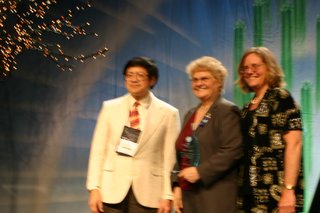
Tonight was the ChemLuminary Awards. This is a big night for ACS volunteers because it is the night when the ACS committees recognize the work of the ACS volunteers who run the programs for the membership. The North Jersey Section was nominated for several awards. We won the "Outstanding Local Section Career Program Award" for our "Careers in Transition" program that help members to obtain new positions in industry and teaching.
Here is a photo of Val Kuck accepting the award from the Chairman of the Committee on Economic and Professional Affairs and Katy Hunt President elect of the ACS.

The other award that our section won is the "ACS Student Affiliates Chapter Interaction Award"
Here is a photo of Bill Suits accepting the award from Joe Heppert Chair of the Society Committee on Education and Kathy Hunt President Elect of the ACS. Posted by Picasa

Friday, September 08, 2006

American Chemical Society National Meeting San Francisco

As an American Chemical Society Councilor I am able to attend both National Meetings of the American Chemical Society. The fall meeting this year is held in San Francisco from September 8 to 14. Since I do not fly I went to the meeting via Amtrak from Trenton NJ to San Francisco.

Society Committee on Education (SOC ED) Meeting

Since I am a member of the Society Committee on Education(SocED) I had plenty of things to do on the train since we had a lot of items on the agenda for this meeting. Soc ED meets in sub committee on September 7th. There are two subcommittee's one for K-12 and one for Higher Education. I am a member of the K-12 subcommittee because of my year's of working with Pre-College teachers as the New Jersey Statewide Systemic Initiative Regional Director.
Here are some of the items that came up at this meeting.
1. They are thinking about the formation of a high school chemistry teacher affiliate group. I must emphasize thinking about. Nothing is etched in stone. They decided at this meeting to determine if there is a need for this organization and also to find out what organization already exist. For example the North Jersey Section has an on going Teacher Affiliate group which is very active. This was started by the teachers and continues to be run by the teachers. Many teachers are full members of the ACS and have become chair's of the Section or Secretary. Currently Diane Krone is the Chair -elect of the NJACS and BettyAnne Howson is the secretary. Both are high school teachers.
2. High School Chemistry Clubs. This is a pilot program which was started last academic year and there were 15 active clubs nationwide. There were no clubs in New Jersey, but we would like to have one established in New Jersey especially in the urban school districts. Teachers can sign up to establish High School chemistry clubs.
3. We heard from James Brown of the Office of Legislative Affairs (OLGA). The good news is that funding for science education has a high priority in congress after the war. Mr Brown urged ACS members to become members of the Legislative Action Network (LAN). Congress does listen to the members so when an alert comes out members should take action. There should also be a local section legislative action committee and North Jersey Section has such a committee. Members are urged to join.
4. ACS is looking for a new director of education due to the retirement of Sylvia Ware. A search was undertaken which only yielded two names and one dropped out. A new search was initiated and there are now more names to consider. In order to determine the perception of ACS education. This report was reviewed by the committee. The bottom line is that the ACS has to do a better job of communication because some things perceived as missing in programs are there but it is hard to find them on the web. The ACS is working on improving the web so that improvements should be seen in the near future.
5. The Committee on Professional Training is preparing a booklet on How to Prepare for Graduate School. It will be a web based booklet which students can download as a pdf form. It will be posted on the CPT website http://www.chemistry.org/portal/a/c/s/1/acsdisplay.html?DOC=education\cpt\index.html.

More later. This was a long meeting.

Jeannette Brown

Sunday, August 06, 2006

North Jersey ACS Members at The Biennial Conference on Chemical Education

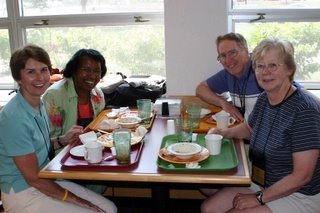
The Biennial Conference on Chemical Education (BCCE) was held last week at Purdue University in West Lafayette, Indiana. Over 1300 chemical educators who teach at the college and secondary school level attended it. There were over 840 papers, which is a record for that event! This meeting is organized by the Division of Chemical Education for chemical educators to exchange the latest information about the teaching and learning of chemistry at every level K-25. The meeting also consists of plenary lectures given by experts for the whole conference. Experts in chemical demonstrations exchange the latest in demonstration and put on a show for the entire conference. Every evening there is a social event after the evening plenary. The meeting is always held on a college campus and most attendees live and eat in the dorms. In fact even if a person opts to live in a near by hotel you can eat in the dorm because that is where you network with other members of the profession and find out informal information.(Photo caption Bettyann, Jeannette, Tom, Diane)
Every year members of the North Jersey Section of the ACS attend this conference. This year three members presented papers, Anita Brandolini, Jeannette Brown and Valerie Kuck. Diane and Tom Krone, and Betty Anne Howson also attended the meeting.

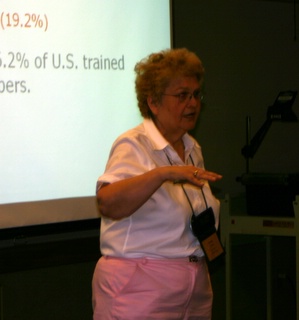
Jeannette Brown and Valerie Kuck (a Purdue alumni) gave presentations in a Symposium entitled " Women in Chemistry Education. Ms Brown's presentation was "The History of African American Women Chemists” Ms Kuck's presentation was "Analysis of the Doctoral Training of faculty members at Research Universities". Both women have done extensive research on their topics and will be publishing books in the future.

(photo caption Val Kuck)

<>
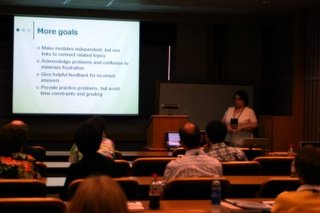
Dr. Brandolini's paper was entitled "The Keys to Chemistry: Interactive Web-Based Tutorials". Her paper was about a simple way for students to learn the background information that they need in order to understand chemistry courses. It is intended for college students whose secondary preparation was not up to par, but it is also being used by current secondary students as a tutorial. (Photo caption Anita Brandolini)
Diane Krone and Bettyanne Howson are high school teachers who attend these conferences for professional development to hone their skills. They spent a lot of time attending the demonstration lectures and POGIL workshops. POGIL is Process Oriented Guide Inquiry Learning, a student -centered discovery-based teaching strategy designed to simultaneously develop content knowledge and key process skills such as critical think and teamwork. This method prepares students for working in teams in college and industry.

(Photo caption The Aldehydes and Ketones whop it up)
Just so you know this meeting is not all work and no play. Sunday night there was an ice cream social sponsored by the Journal of Chemical Education, Monday night there was wine and cheese in the exhibit area and Wednesday night there was music and dancing. The music was played by a pick up band of chemists called "The Aldehydes and Ketones". This group was started two years ago at the Biennial at Iowa State University and was such a hit they came back for an encore presentation at this convention. They played music from the 60's and 70's. They had people such as Dr. Glenn Crosby retired chemical educator, dancing along with the younger chemists!

Thursday, August 03, 2006

Facts about the North Jersey American Chemical Society

The North Jersey Section of the American Chemical Society with 7000 members is the largest local ACS section in the Nation. Our members live or work in all the counties of New Jersey, north of the Raritan River, with the exclusion of parts of Bergen County and all of Hudson County. Our members work in industry, teach in colleges and universities, teach high school work in government or are retired. The major industry in New Jersey is the pharmaceutical industry, but we also work in the electronics, communications and biotechnology industry as well as hospital and government labs.
Our current Chair is Dr. Stephen Waller; he highlights more information about NJACS on the web page http://www.njacs.org/about_njacs.html.
Since we are such a large organization we are divided into topical groups and committee. Our topical groups are: Chromatography, Drug Metabolism, Lab Robotics, Mass Spectrometry, NMR Spectroscopy, Organic, Regulatory and Quality Group and Small Chemical Business. So you can see there is something for everyone. Most of these groups meet monthly in different locations in the North Jersey area. In addition we have committees; Metro Women Chemists, Minority Affairs, Senior Chemists, Younger Chemists, Education, Teacher Affiliates, and Careers. These committees tend to run programs for their members. Membership in topical groups and committee is free to all ACS members. Members of the general public can attend the topical group meetings without being an ACS member but it is encouraged. The committees welcome new members in their groups. More information about our topical groups and committees can be found at http://www.njacs.org/index.html
Our Careers in Transition Group meets once a month to help members get a new job or get a promotion in their present job. This is a very important group for those who might be laid off from a job or are currently thinking about changing jobs.
The Teacher Affiliate Group is very active. Teachers meet once a month in different locations during the school year at a Chem Tag or Chem Central meetings. This is an informal after school meeting where teachers enjoy refreshments and share activities. Younger teachers are able to get their questions answered about some aspect of their teaching by experienced teachers. The experienced teachers also run workshops to teach younger teachers or alternative route teachers cutting edge techniques for the classroom. They also have a list serve called chementhusiasts to help teachers on a daily bases. More information about our teachers groups can be found at: http://www.njacs.org/teacher.html
Please check the NJACS website regularly for updates and information about the section. We are a very active section and we could use volunteers. If you would like to volunteer contact us on the web.http://www.njacs.org/volunteers.html
Book mark this blog for the latest news about our section.